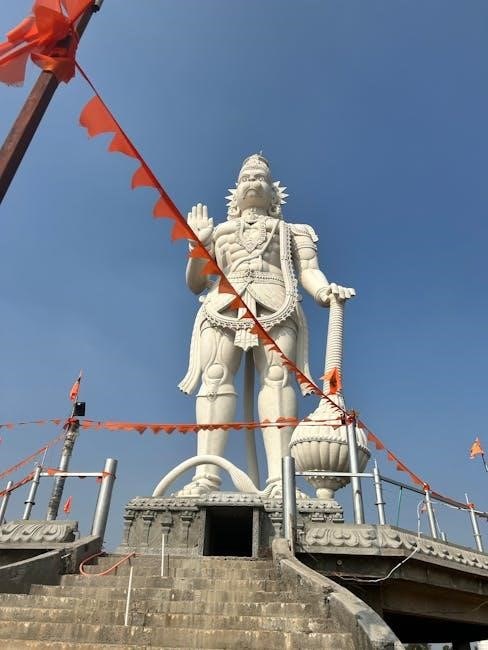
Hanuman Chalisa in Sanskrit: A Comprehensive Guide (Updated September 3, 2026)
Seeking authentic Sanskrit Hanuman Chalisa PDFs requires careful navigation, ensuring accurate transcriptions from reputable online sources, avoiding incomplete or misleading versions.
Historical Context of the Hanuman Chalisa
The Hanuman Chalisa’s origins are deeply rooted in 16th-century North India, a period characterized by significant political and social upheaval. Written by Tulsidas, the hymn arose amidst shifting empires and widespread uncertainty, reflecting the era’s anxieties and spiritual yearning.
Tulsidas, a pivotal figure in the Bhakti movement, composed the Chalisa in the vernacular language of Awadhi, making it accessible to the common people. This contrasted with the prevalent use of Sanskrit in religious texts, traditionally reserved for the priestly class. The Chalisa’s popularity quickly spread, becoming a beloved devotional practice across diverse communities.
Interestingly, the search for Sanskrit versions and PDFs today stems from a desire to connect with the text’s deeper, potentially more ancient roots, even though the original wasn’t composed in Sanskrit.
Tulsidas and the 16th Century
Tulsidas, born in 1532, was a prominent poet and saint during the reign of the Mughal emperor Akbar. His life coincided with a period of cultural synthesis and religious reform in India. Despite Mughal rule, Hinduism flourished, and Tulsidas became a leading voice within the Bhakti movement, emphasizing devotion and personal connection with the divine.
He is best known for composing the Ramcharitmanas, a retelling of the Ramayana in Awadhi, and the Hanuman Chalisa. The availability of Hanuman Chalisa PDFs, including those attempting Sanskrit renderings, reflects the enduring legacy of Tulsidas’s work. His emphasis on accessible devotion continues to resonate today.
Tulsidas’s writings were deeply influenced by the social and political climate of his time, offering solace and spiritual guidance to a populace navigating change.
The Bhakti Movement’s Influence
The Bhakti movement, a devotional trend sweeping across India from the 8th to the 16th centuries, profoundly shaped the Hanuman Chalisa. This movement prioritized personal experience and love for God over rigid ritualism, fostering inclusivity and accessibility. Tulsidas, a key figure, channeled this ethos into his compositions, making devotion to Rama and Hanuman widely available.
The widespread distribution of Hanuman Chalisa PDFs today is a direct consequence of the Bhakti movement’s emphasis on vernacular devotion. Sanskrit, while revered, wasn’t universally understood, prompting works in local languages.
This movement’s impact continues, evidenced by the numerous digital versions available, catering to diverse linguistic and devotional preferences.

Understanding the Hanuman Chalisa Text
Exploring Sanskrit translations of the Hanuman Chalisa reveals nuanced interpretations, differing slightly across versions, yet maintaining the core devotional essence found in PDFs.
Original Language and Script
The Hanuman Chalisa was originally composed by Tulsidas in Awadhi, a dialect of Hindi, during the 16th century. While not Sanskrit itself, its profound spiritual impact led to numerous Sanskrit translations and adaptations, readily available today as downloadable PDFs. These Sanskrit versions aim to preserve the hymn’s essence within the classical Indian linguistic tradition.
The original script used was Devanagari, and this remains the most common script for both Hindi and Sanskrit versions found in PDF format. However, transliterations into other scripts, like Romanization, also exist, though they are less prevalent for devotional texts. When searching for a Sanskrit Hanuman Chalisa PDF, verifying the script’s accuracy is crucial for proper recitation and understanding. Authentic PDFs will consistently employ Devanagari for the Sanskrit verses.
Sanskrit Translations and Adaptations
Numerous Sanskrit translations of the Hanuman Chalisa exist in PDF format, reflecting the hymn’s widespread reverence and the desire to present it within the framework of Vedic tradition. These aren’t literal word-for-word conversions, but rather adaptations that capture the bhava (essence) of Tulsidas’s original Awadhi verses.
Adaptations often employ sophisticated Sanskrit poetic meters and vocabulary, enhancing the hymn’s aesthetic and spiritual power. Finding a reliable Sanskrit PDF requires discernment, as variations in interpretation and transliteration are common. Some PDFs offer commentary alongside the verses, explaining the Sanskrit grammar and philosophical underpinnings. Others present a more direct translation. Careful review is essential to ensure the PDF aligns with established scholarly interpretations.
Variations in Sanskrit Versions
When exploring Hanuman Chalisa PDFs in Sanskrit, be aware of inherent variations. These stem from differing interpretations of Tulsidas’s Awadhi verses and the subjective choices made by translators. Some versions prioritize literal accuracy, while others emphasize poetic flow and devotional resonance.
Transliteration differences also contribute to variations; different schemes for representing Sanskrit sounds in Roman script (IAST, for example) can lead to discrepancies. Furthermore, PDFs may include slight textual variations due to copying errors or editorial choices. Comparing multiple Sanskrit PDFs from reputable sources is crucial for identifying a consistent and accurate rendition. Recognizing these nuances ensures a deeper appreciation of the hymn’s rich textual history.

Key Verses and Their Sanskrit Equivalents
Sanskrit PDFs reveal translations of iconic verses like ‘Jai Hanuman Gyan Gun Sagar’ and ‘Ram-Dut Atulit Baldhama’, offering deeper linguistic and devotional insights.
‘Jai Hanuman Gyan Gun Sagar’ ⎼ Sanskrit Translation
Examining Sanskrit Hanuman Chalisa PDFs reveals nuanced translations of this pivotal verse. While direct, word-for-word equivalents are complex due to poetic license, common renderings emphasize Hanuman’s vast knowledge (‘Gyan’) and virtuous qualities (‘Gun’).
PDFs often present variations, reflecting different schools of Sanskrit interpretation. Some versions utilize elaborate compound words to capture the depth of meaning within the original Awadhi. Accurate PDFs will include transliteration alongside Devanagari script, aiding pronunciation.
The core essence conveyed is Hanuman as an ocean of wisdom and virtue. Comparing multiple PDF sources is crucial to appreciate the richness of Sanskrit’s expressive capabilities when rendering this beloved devotional line. Authentic versions prioritize maintaining the devotional spirit alongside linguistic accuracy.
‘Ram-Dut Atulit Baldhama’ ‒ Sanskrit Rendering
Sanskrit Hanuman Chalisa PDFs demonstrate diverse approaches to translating “Ram-Dut Atulit Baldhama.” This verse highlights Hanuman’s unparalleled strength (‘Atulit Baldhama’) and unwavering devotion as Rama’s messenger (‘Ram-Dut’). PDFs showcase varying levels of literalness and poetic adaptation.
Some renderings employ sophisticated Sanskrit grammar to convey the intensity of Hanuman’s power and loyalty. Others prioritize clarity, opting for simpler phrasing. Examining multiple PDFs reveals the challenges of encapsulating the verse’s essence within Sanskrit’s structure.
Authentic PDFs will maintain the reverence inherent in the original Awadhi. Look for versions that accurately reflect Hanuman’s extraordinary capabilities and his selfless service to Lord Rama, ensuring a faithful and meaningful Sanskrit representation.
‘Anjani-Putra Pawan Sut-Nama’ ‒ Sanskrit Equivalent
Sanskrit Hanuman Chalisa PDFs present varied translations of “Anjani-Putra Pawan Sut-Nama,” acknowledging Hanuman’s divine parentage. ‘Anjani-Putra’ signifies his mother, Anjana, while ‘Pawan Sut-Nama’ denotes his father, the wind god, Vayu. PDFs demonstrate differing approaches to expressing this unique lineage in Sanskrit.
Some PDFs utilize precise Sanskrit terms for ‘son’ and ‘wind,’ maintaining a literal translation. Others employ more evocative language, emphasizing Hanuman’s celestial origins and inherent power. Comparing several PDFs reveals nuances in conveying the verse’s spiritual depth.
Authentic PDFs will accurately reflect Hanuman’s divine birth and connection to the elements. Look for versions that honor his extraordinary heritage, ensuring a respectful and meaningful Sanskrit rendering of this pivotal verse.

Benefits of Reciting the Hanuman Chalisa (According to Tradition)
Sanskrit Hanuman Chalisa PDFs facilitate accessing these benefits, offering a pathway to spiritual growth, obstacle removal, and deepened devotion to Lord Rama.
Spiritual Benefits
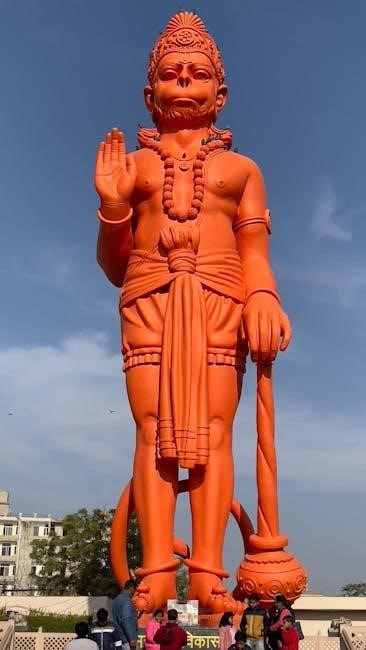
Accessing a Sanskrit Hanuman Chalisa PDF unlocks profound spiritual advantages for dedicated practitioners. The verses, when recited in their original linguistic form, are believed to resonate with heightened energy, fostering a deeper connection with the divine.
The precise Sanskrit pronunciation, facilitated by accurate PDF transcriptions, is crucial for maximizing these benefits. Chanting the Chalisa in Sanskrit is thought to purify the mind, cultivate inner peace, and accelerate spiritual evolution.
Furthermore, the PDF format allows for consistent study and memorization of the verses, strengthening devotion and promoting a more intimate relationship with Hanuman and, ultimately, Lord Rama. Authentic PDFs ensure the preservation of the hymn’s sacred power and intended meaning, amplifying its positive spiritual impact.
Removal of Obstacles (Vighna Nashak)
A Sanskrit Hanuman Chalisa PDF serves as a potent tool for overcoming life’s challenges, embodying the ‘Vighna Nashak’ tradition. Hanuman, revered for his unwavering devotion and strength, is believed to swiftly dismantle obstacles in the path of his devotees.
Utilizing a correct PDF transcription ensures accurate recitation of the verses, amplifying their protective and problem-solving energies. Consistent chanting, guided by the Sanskrit text, is thought to neutralize negative influences and create a shield against adversity.
The precise articulation of the Sanskrit sounds, available through reliable PDFs, is key to invoking Hanuman’s blessings for removing hurdles – be they financial, relational, or spiritual. This practice fosters courage, resilience, and a steadfast faith in overcoming difficulties.
Strengthening Devotion to Rama
A Sanskrit Hanuman Chalisa PDF profoundly deepens one’s bhakti (devotion) towards Lord Rama, as the hymn itself is a testament to Hanuman’s unparalleled allegiance. The verses, when recited from an accurate Sanskrit source, vividly portray Hanuman’s selfless service and unwavering love for Rama.
Accessing a reliable PDF allows for correct pronunciation and understanding of the Sanskrit lyrics, fostering a more intimate connection with the narrative. This focused engagement cultivates a heart filled with reverence and a desire to emulate Hanuman’s devotion.
Through consistent chanting using the Sanskrit text, devotees aim to internalize Hanuman’s qualities, ultimately strengthening their own spiritual bond with Rama and experiencing divine grace.
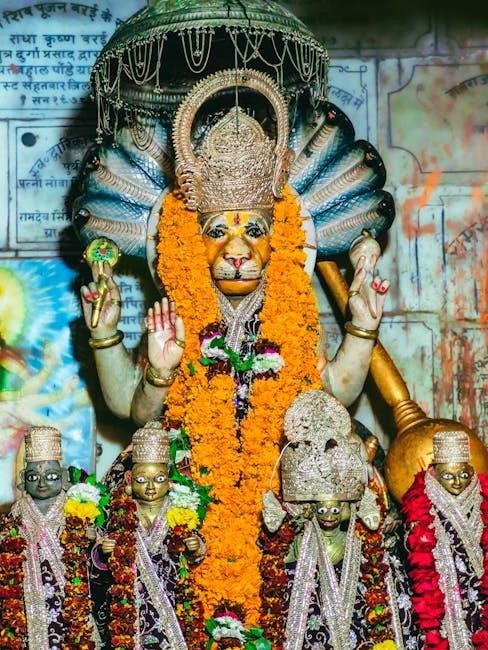
Finding Authentic Hanuman Chalisa PDFs in Sanskrit
Locating genuine Sanskrit Hanuman Chalisa PDFs demands diligence; prioritize reputable online platforms and meticulously verify transcriptions for accuracy and completeness.
Reputable Online Sources
Several online resources offer Hanuman Chalisa PDFs, but discerning authenticity is crucial. Websites associated with established Hindu organizations and temples often provide reliable transcriptions. Look for platforms dedicated to Sanskrit literature and Vedic studies, as they prioritize accuracy.
Digital libraries specializing in religious texts can also be valuable. Ensure the source clearly indicates the Sanskrit version’s lineage and any scholarly review it has undergone. Beware of websites with excessive advertisements or unclear copyright information. Prioritize sites offering downloadable PDFs directly, rather than those redirecting to external links.
Always cross-reference multiple sources to confirm consistency in the Sanskrit verses and transliteration. Checking for endorsements from respected Sanskrit scholars or institutions adds another layer of assurance when downloading a Hanuman Chalisa PDF.
Identifying Accurate Transcriptions
Verifying the accuracy of a Sanskrit Hanuman Chalisa PDF requires a keen eye for detail. Compare the Sanskrit text with known, established versions found in traditional printed books or from respected Sanskrit scholars. Pay close attention to the correct use of diacritics – markings indicating pronunciation – as these are vital in Sanskrit.
Look for consistency in the transliteration; the Roman script representation should align with standard Sanskrit transliteration rules. Inaccurate transliteration can alter the meaning of the verses. Check for complete verses, ensuring no portions are missing or altered.
A reliable PDF will also include a clear indication of the script (Devanagari) and any accompanying commentary or explanation from a knowledgeable source, bolstering its credibility.
Avoiding Misleading or Incomplete PDFs
The internet hosts numerous Hanuman Chalisa PDFs, but quality varies drastically. Beware of sources offering drastically different versions or those lacking any scholarly attribution. Incomplete PDFs, missing verses or containing significant textual errors, should be immediately discarded as they compromise the hymn’s integrity.
Be cautious of PDFs with overly simplistic or sensational claims regarding immediate benefits, as genuine spiritual practice requires dedication. Look out for PDFs with poor formatting, inconsistent fonts, or obvious scanning artifacts, indicating a lack of careful preparation.
Prioritize PDFs from established institutions or individuals known for their expertise in Sanskrit and Hindu scriptures, ensuring authenticity and reliability.

Pronunciation and Chanting Guidelines
Correct Sanskrit pronunciation is vital; PDFs often lack phonetic guidance. Mastering ‘maatra’ (syllable length) enhances chanting, deepening devotion and spiritual resonance.
Correct Sanskrit Pronunciation
Achieving accurate Sanskrit pronunciation when reciting the Hanuman Chalisa, even with a PDF, presents unique challenges. Many readily available PDFs lack the necessary diacritical markings to guide non-native speakers through the nuanced sounds of Sanskrit. This can lead to mispronunciation, potentially altering the vibrational effect of the mantras.
Focus on vowel sounds and nasalization. Sanskrit utilizes a complex system of vowels, some of which don’t have direct equivalents in English. Pay close attention to the length of vowels – short versus long – as indicated (though often missing in basic PDFs). Nasal sounds are also crucial and require practice.
Consider audio resources alongside the PDF. Supplementing your study with recordings of native Sanskrit speakers chanting the Hanuman Chalisa is highly recommended. This allows you to hear the correct pronunciation and rhythm, improving your own recitation and deepening your connection to the divine.
Importance of ‘Maatra’ (Syllable Length)
The concept of ‘Maatra,’ or syllable length, is paramount in Sanskrit chanting, and often overlooked when using a Hanuman Chalisa PDF. Each syllable possesses a specific duration, influencing the mantra’s power and resonance. Simply reading the Devanagari script from a PDF isn’t enough; understanding the ‘Maatra’ is vital for correct articulation.
Short and long vowels drastically alter pronunciation and meaning. A PDF might visually represent the letters, but it rarely indicates the precise length of each vowel sound. Incorrect ‘Maatra’ can distort the mantra’s energy and diminish its effectiveness.
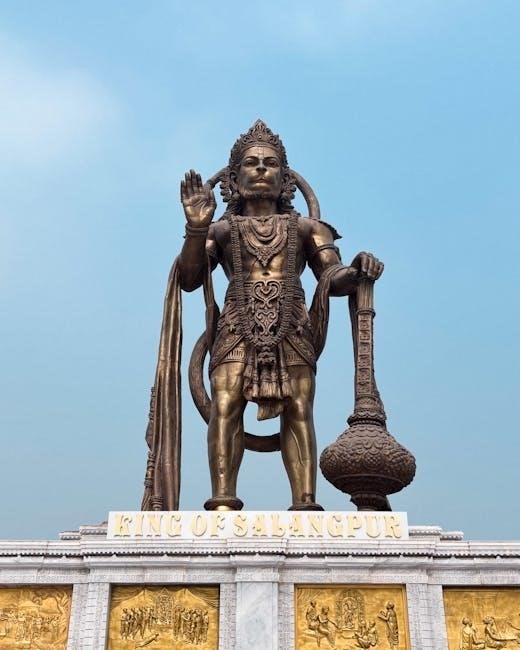
Experienced teachers or audio guides are invaluable. To truly grasp ‘Maatra,’ seek guidance from a qualified Sanskrit instructor or utilize audio recordings that demonstrate the correct pronunciation and rhythmic flow. This ensures the Hanuman Chalisa’s potency is fully realized.
Recommended Chanting Practices
While a Hanuman Chalisa PDF provides the text, optimal chanting transcends mere recitation. Begin with a clean space and a focused mind, establishing a respectful atmosphere. Consistent daily practice, even a few verses, yields greater benefits than sporadic, lengthy sessions.
Chanting with devotion (Bhakti) is key. Visualize Hanuman and Rama during recitation, fostering a deeper connection. Consider using a mala (rosary) to maintain count and rhythm.
Audio guidance from a PDF’s accompanying resources can be helpful initially, but strive to internalize the rhythm and pronunciation. Tuesdays are particularly auspicious for Hanuman worship, but any time dedicated with sincerity is valuable. Regular practice amplifies the spiritual impact.
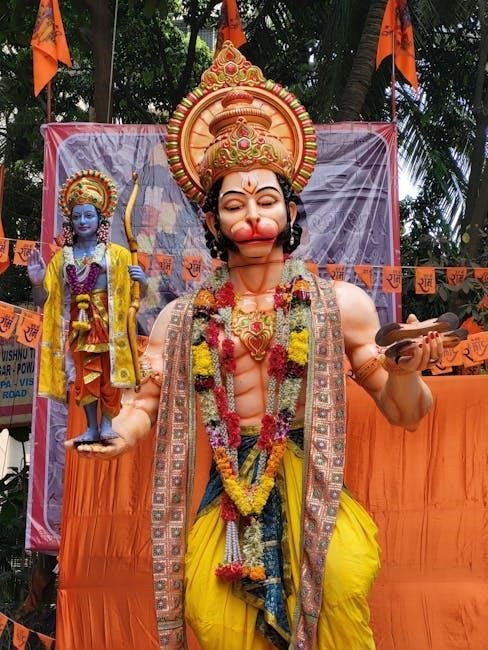
Hanuman Chalisa and Vedic Astrology
Astrological connections link Hanuman to Mars, and chanting the Chalisa—found in Sanskrit PDFs—can act as a potent remedy for planetary imbalances.
Planetary Influences and Remedies
Vedic astrology deeply intertwines with the Hanuman Chalisa, particularly concerning the planet Mars (Mangal). Individuals experiencing adverse effects from a weak or afflicted Mars in their birth chart often turn to the Chalisa for remedial measures. Accessing authentic Sanskrit versions, often available as PDFs, is crucial for maximizing the beneficial effects.
The consistent recitation of the Chalisa, utilizing a correctly transcribed Sanskrit PDF, is believed to appease Mars, mitigating its negative influences and fostering courage, energy, and determination. Specific mantras within the Chalisa directly address Martian energies. Finding a reliable PDF ensures the correct pronunciation and syllable emphasis, vital for astrological efficacy.
Furthermore, the Chalisa’s verses are thought to harmonize planetary imbalances, promoting overall well-being and spiritual growth.
Hanuman’s Association with Mars (Mangal)
Hanuman is profoundly linked to the planet Mars (Mangal) in Vedic astrology, embodying its qualities of courage, strength, and unwavering devotion. This connection explains why reciting the Hanuman Chalisa, particularly using a Sanskrit PDF for accurate pronunciation, is a potent remedy for mitigating negative Martian influences.
Mars governs energy, vitality, and initiative; Hanuman exemplifies these traits. A weakened Mars in a birth chart can manifest as lethargy, aggression, or obstacles. Chanting the Chalisa, sourced from a verified Sanskrit PDF, is believed to invigorate and balance this planetary energy.
The Chalisa’s verses, when recited correctly from a reliable PDF, act as a powerful invocation, channeling Hanuman’s Martian energy to overcome challenges and foster inner strength.
Specific Days for Chanting (e.g., Tuesdays)
Tuesdays are considered the most auspicious day for reciting the Hanuman Chalisa, due to the planet Mars (Mangal) ruling this day – and Hanuman’s strong association with Mars. Utilizing a Sanskrit Hanuman Chalisa PDF on Tuesdays amplifies the beneficial effects of the chanting, enhancing spiritual potency.
However, chanting isn’t limited to Tuesdays. Any day dedicated to devotion is suitable, but consistency is key. Accessing a correct Sanskrit PDF ensures accurate pronunciation, vital for maximizing the hymn’s power.
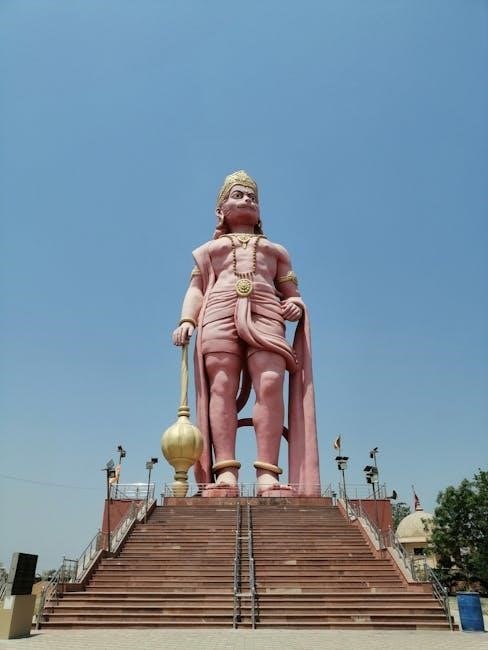
Special occasions like Hanuman Jayanti also hold immense significance. Reciting the Chalisa from a verified PDF on these days is believed to yield exceptional blessings and accelerate spiritual progress.